Does Mental Health First Aid® Really Work?

The evidence says yes. Here's what research involving nearly 6,000 participants tells us.
Many people ask an important question before enrolling in a Mental Health First Aid® (MHFA®) course:
"Does it actually work?"
It's a fair question. While the idea of learning how to support someone experiencing a mental health problem sounds valuable, many people want to know whether the training leads to real improvements—not just in knowledge, but in confidence and helping behaviour.
The encouraging answer is yes.
A large systematic review published in PLOS ONE examined the results of 18 controlled studies involving almost 6,000 participants. The researchers found that Mental Health First Aid® training consistently improved mental health knowledge, increased confidence to help others, reduced stigma and encouraged participants to provide support when someone was experiencing a mental health problem.
Rather than relying on opinion or individual experiences, this research provides strong evidence that MHFA® training produces measurable and meaningful outcomes.
Why does the evidence matter?
Mental health challenges affect individuals, families, workplaces and communities every day.
Many people genuinely want to help a friend, family member, colleague or neighbour who may be struggling, but they simply don't know what to say or do. Others worry about saying the wrong thing and choose to remain silent.
Mental Health First Aid® bridges that gap.
It gives everyday people practical skills to recognise when someone may need support, start a conversation with confidence and guide them towards appropriate professional help while continuing to provide reassurance and encouragement.
Just as physical first aid doesn't replace medical treatment, MHFA® doesn't replace mental health professionals. Instead, it provides immediate support until appropriate help is available.
What did the research find?
The review identified several important benefits that were consistently seen across the studies.
People learned to recognise mental health problems earlier.
Participants showed significantly better mental health knowledge after completing MHFA® training. They became more confident in recognising the signs and symptoms of common mental health problems and understanding when someone may need support.
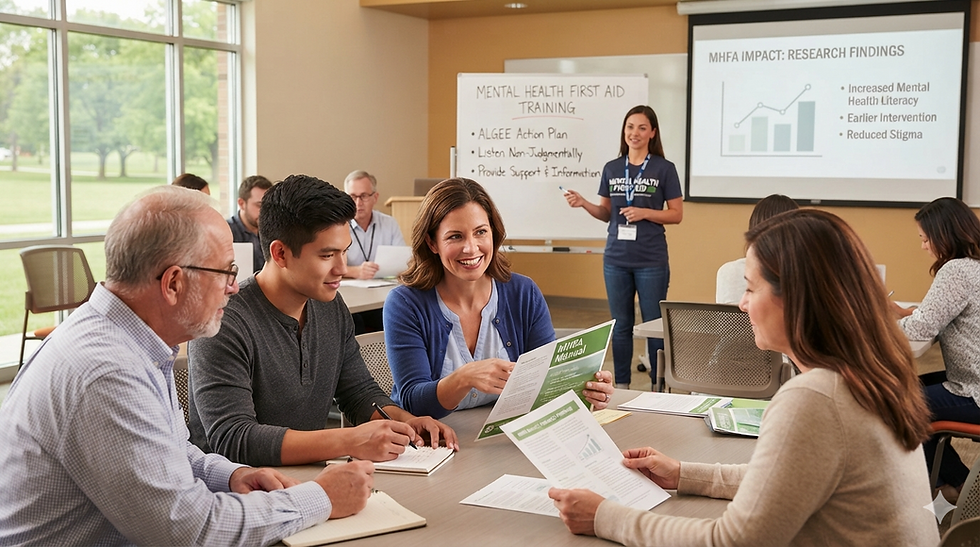
People felt more confident to help.
One of the biggest barriers to supporting someone is uncertainty.
MHFA® training increased participants' confidence in approaching someone, starting a supportive conversation and offering appropriate assistance without judgement.
Knowing how to begin a conversation often makes all the difference.
Stigma was reduced.
The research also found improvements in attitudes towards people experiencing mental health problems.
Greater understanding helped reduce misconceptions and encouraged participants to respond with empathy rather than judgement.
Reducing stigma makes it more likely that people will seek help earlier and feel supported throughout their recovery.
More people actually offered support.
Perhaps the most encouraging finding was that participants didn't simply gain knowledge—they were more likely to put that knowledge into practice.
Following MHFA® training, people reported providing more support to friends, family members and colleagues experiencing mental health problems.
This demonstrates that MHFA® is about much more than learning information; it helps people take positive action when someone needs support.
What does this mean for workplaces?
MHFA® training benefits more than individual participants.
When workplaces invest in Mental Health First Aid® training, they help create environments where staff are more confident recognising signs of distress, supporting colleagues appropriately and encouraging early access to professional help.
These conversations contribute to psychologically safer workplaces where mental health can be discussed openly and respectfully.
For organisations, this can lead to greater awareness, stronger teamwork and a more supportive workplace culture.
Building stronger communities
The benefits of MHFA® extend well beyond the workplace.
Parents, grandparents, sporting clubs, volunteers, teachers, neighbours and community members all have opportunities to support someone experiencing a mental health problem.
The more people within a community who understand Mental Health First Aid® principles, the more likely it becomes that someone experiencing difficulties will receive compassionate support and encouragement to seek help.
Sometimes, one conversation can make a significant difference.
The evidence says yes.
The research is clear.
Mental Health First Aid® training improves knowledge, builds confidence, reduces stigma and increases supportive helping behaviours.
Most importantly, MHFA® gives everyday people practical skills they can use when someone around them needs support.
You don't need to be a mental health professional to make a difference.
Sometimes, knowing how to ask "Are you okay?" and listening without judgement can be be the first step towards someone's recovery.
Learn the skills. Make a difference.
At Safe Harbour Minds, we deliver accredited Mental Health First Aid® (MHFA®) training that equips individuals, workplaces and community groups with practical, evidence-based skills to recognise, respond and support someone experiencing a mental health problem.
Whether you're looking to strengthen your workplace, support your community or simply feel more confident helping someone you care about, Mental Health First Aid® can make a real difference.
Explore our upcoming courses or browse our Mental Health Resources to learn more.
References
Bond, K. S., Jorm, A. F., Kitchener, B. A., & Reavley, N. J. (2018). Mental Health First Aid training for the public: Evaluation of effects on knowledge, attitudes and helping behaviour using meta-analysis. PLOS ONE, 13(5), e0197102.
Mental Health First Aid Australia. (2026). Mental Health First Aid Australia.

