Men's Mental Health: When Silence Becomes a Concern

Recognising when someone may be struggling, starting difficult conversations and understanding how to respond.
Content note: Suicide and mental health
This article discusses suicide, suicidal thoughts and mental health difficulties. Some readers may find this content distressing or personally confronting.
Please consider your own wellbeing before continuing. You may choose to read the article at another time or not continue.
If you or someone you know needs support, contact Lifeline on 13 11 14 or the Suicide Call Back Service on 1300 659 467.
Additional support information is provided at the end of this article.
If someone is in immediate danger, call 000.

November provides an opportunity to focus on men's health through Movember and International Men's Day on 19 November. While men's health encompasses many important issues, one subject deserves particular attention: suicide prevention.
Suicide affects individuals, families, workplaces and entire communities. Behind every statistic is a person, and behind every death are people whose lives are forever changed.
At Safe Harbour Minds, we believe greater awareness, understanding and the confidence to respond can make a meaningful difference.
Understanding the scale of the problem
The latest figures from the Australian Bureau of Statistics (ABS), released on 27 October 2026, show that 2,425 Australian men died by suicide in 2025.
Men accounted for 73.9% of all suicide deaths in Australia that year — nearly three out of every four.
The male age-standardised suicide rate was 17.3 deaths per 100,000 people, down from 18.4 in 2024.
Although this reduction is encouraging, the figures remain deeply concerning. The 2025 data is preliminary and may be revised as coronial investigations are completed.
Suicide was also Australia's leading cause of premature death in 2025, measured by years of potential life lost.
These statistics tell us something important about the scale of the problem, but they cannot explain the circumstances or experiences of any individual person.
Understanding what may contribute to suicidal thoughts, recognising when someone is struggling and knowing how to respond are equally important.
Suicide affects everyone
While this article focuses on men's mental health during Movember, it is important to recognise that suicide is not exclusively a men's issue.
Women and people of all gender identities can experience suicidal thoughts and behaviours, and every life lost to suicide is a tragedy.
The higher proportion of suicide deaths among men highlights an important area for prevention, but it should never diminish the experiences of others who may be struggling.
Regardless of gender, everyone deserves to be heard, supported and able to access appropriate help when they need it.
What recent Australian research tells us
Recent Australian research provides valuable insights into how suicidal thoughts can develop and change over time.
A 2025 study by Haregu and Armstrong followed Australian men participating in the Ten to Men longitudinal study over approximately nine years.
Among men who had not previously reported suicidal thoughts, 19.2% reported experiencing them during the follow-up period.
Encouragingly, the study also found that 65.5% of men with a previous history of suicidal thoughts did not report further suicidal thoughts during the periods assessed at subsequent surveys.
Further research published in 2026 highlighted that suicidal thoughts and behaviours can also recur, reinforcing the importance of ongoing support.
Together, these findings remind us that suicidal thoughts can develop at different stages of life, experiences can change, and improvement is possible.
They also reinforce an important message: support should not necessarily end after one conversation.
Why some men find it difficult to seek help
There is no single explanation for why someone experiences suicidal thoughts.
Mental health difficulties, relationship problems, financial pressures, physical health concerns, social isolation and significant life changes may all contribute to distress.
For some men, expectations about independence, strength or managing problems alone may make it more difficult to acknowledge distress or seek support.
However, we should avoid assuming that all men experience or express difficulties in the same way.
Some speak openly about their mental health. Others may find conversations uncomfortable or prefer to express their concerns differently.
What matters is recognising when someone may be struggling and creating opportunities for supportive conversations without judgement.
Recognising when someone may be struggling
Changes in a person's behaviour, mood or circumstances can sometimes indicate that they are experiencing significant distress.
These might include:
Withdrawing from friends, family or usual activities.
Expressing hopelessness or feeling like a burden.
Noticeable changes in mood, sleep or behaviour.
Increased use of alcohol or other substances.
Significant distress following relationship, financial or personal difficulties.
Talking about death, suicide or feeling that life is no longer worth living.
No single behaviour confirms that someone is thinking about suicide. Some people may show few obvious signs.
However, concerning changes or statements should not be dismissed.

Starting a difficult conversation
When you're worried about someone, starting a conversation can feel uncomfortable.
You might be unsure what to say, worry about making things worse or feel concerned that the person won't want to talk.
A simple expression of concern can be a useful starting point:
"I've noticed you haven't seemed yourself lately. How have things been going?"
Give the person time to respond. Listen without judgement, avoid rushing to offer solutions and take their concerns seriously.
You don't need to have all the answers.
Sometimes the most important first step is helping someone feel heard and supported.
Asking directly about suicide
If you're concerned that someone may be thinking about suicide, it is important to ask clearly and compassionately.
For example:
"Are you having thoughts of suicide?"
Asking directly about suicide does not put the idea into someone's head. Instead, it can provide an opportunity for the person to talk openly about what they are experiencing.
Remain calm, listen carefully and take their response seriously.
When someone tells you they are thinking about suicide
If someone discloses suicidal thoughts, they deserve a compassionate response and appropriate support.
Avoid dismissing their feelings, making promises of secrecy or assuming that the conversation alone has resolved the situation.
Encourage connection with appropriate professional or crisis support. Where possible, help the person make that connection rather than simply giving them a telephone number.
If there is an immediate risk to their safety, stay with them where safe to do so and contact emergency services on 000.
Supporting someone who is experiencing suicidal thoughts is not about taking responsibility for solving every problem. It is about recognising the seriousness of the situation and helping them access appropriate assistance.
The importance of continued support
The 2026 Australian research highlights that suicidal thoughts and behaviours may recur.
This reminds us that support should not necessarily end after one conversation or an initial period of improvement.
Checking in again, maintaining connection and encouraging appropriate ongoing care can all be meaningful ways of showing someone that they have not been forgotten.
Where Mental Health First Aid® fits
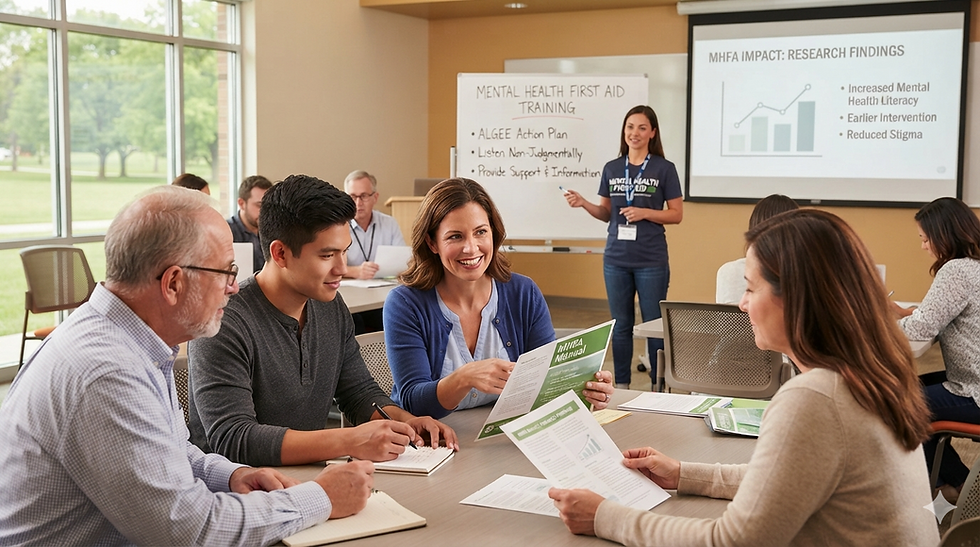
Mental Health First Aid® (MHFA®) training helps people develop the knowledge and confidence to recognise mental health problems and crises, offer initial support and encourage appropriate professional help.
At Safe Harbour Minds, our Standard Mental Health First Aid® course includes learning about responding to suicidal thoughts and behaviours.
The aim is not to turn participants into mental health professionals. It is to help everyday people feel better prepared to recognise when someone may need assistance and respond appropriately.
Because mental health concerns can arise in workplaces, families, sporting clubs and communities, these skills are relevant to all of us.
A conversation worth having
The statistics surrounding suicide among Australian men are concerning, but they should not leave us feeling powerless.
The research also reminds us that suicidal thoughts can subside and that people's circumstances can change.
We cannot always know what someone else is experiencing. But we can notice when something seems wrong, listen without judgement, take concerns seriously and encourage appropriate support.
During Movember, International Men's Day and beyond, let's continue building communities where men feel able to speak about their mental health and where others feel confident to respond.
Because Mental Health is everyone's business.
Support is available
If you or someone you know needs support:
Lifeline: 13 11 14 — 24-hour crisis support.
Suicide Call Back Service: 1300 659 467 — telephone and online counselling.
MensLine Australia: 1300 78 99 78 — support for Australian men.
Emergency assistance: Call 000 if someone's life is in immediate danger.
References and further reading
Australian Bureau of Statistics. (2026). Intentional self-harm (suicide) deaths, 2025.https://www.abs.gov.au/statistics/health/causes-death/intentional-self-harm-suicide-deaths/2025
Haregu, T., & Armstrong, G. (2025). Understanding the onset and remission of suicidal thoughts in Australian men: Findings from the Ten to Men study. Australian & New Zealand Journal of Psychiatry, 59(7), 612–621. https://doi.org/10.1177/00048674251333572
Haregu, T., Zhang, S., Young, J., & Armstrong, G. (2026). Examining the chronicity of suicidal thoughts and behaviors among Australian males. Social Psychiatry and Psychiatric Epidemiology. https://doi.org/10.1007/s00127-026-03172-7
Lifeline Australia: https://www.lifeline.org.au
Suicide Call Back Service: https://www.suicidecallbackservice.org.au
MensLine Australia: https://mensline.org.au